Inside a £14.5m American dairy

Tri-Cross Dairy was built eight years ago on an 80-acre greenfield site in South Dakota.  We took a tour of the state-of-the-art 5,200-cow unit.

Established by Californian dairymen Tom Koolhaas and his brother-in-law Wes Bylsma, Tri-Cross Dairy was born out of the challenges facing the dairy industry in California where expansion is near-impossible.

Lured by lower land prices, the brothers decided to expand by travelling northeast to Viborg, South Dakota. Here, land is a fraction of the price of California (£6,500/acre rather than £26,000). In the past 10 years, more than 40 large dairies have been established in the State, many by farmers from California, reveals Tom, a former accountant with a penchant for numbers. The 80-acre greenfield site cost £14.5m ($20m) and is expected to pay for itself within 15 years. 

The dairy was originally populated with 800 cows trucked in from other dairies owned by the duo in California. “It was a 30-hour drive,” recalls Tom. “Cows never got off the truck. When they did, the milk filters looked like cottage cheese, but within four to five milkings, the cell counts came down—and we didn’t lose a single cow.”


Tri-Cross Dairy

About the unit

Tri-Cross now milks 5,200 ProCROSS cows. The dairy is managed by Steve Broersma and a workforce of 35 employees operating on 12-hour shifts, five days on, two off. Housing is provided, with the dairy covering the first £73 of monthly bills. “The rest is deducted from their pay cheque,” says Tom, who explains it is easier to keep utilities in the business’s name.

Initially, 2,000 Holsteins were purchased to reach target numbers, but these have been phased out and genetics now comprise 95% ProCROSS – a three-way cross of Coopex Montbéliarde, VikingRed, and VikingHolstein. “My father-in-law Willie Bylsma started crossbreeding in 1999. Most of the ProCROSS at Tri-Cross are now in their third generation,” adds Tom.

Approximately 4,400-head are milked three times daily through a 100-point GEA rotary parlour, while another 800 low-yielding cows (over 170 days in milk (DIM)) are milked twice daily. Milking is a five-man job, including collecting cows, with 750-800 cows milked per hour. Cows are housed in a state-of-the-art shed spanning 600×1,100 ft (200×400m).

With temperatures ranging from -6°C in the winter to 37°C in the summer, ventilation is critical. A cross-ventilation system with 176 fans replaces air every 45 seconds. “It costs double in summer, but it’s non-negotiable. Without it, cows die,” says Tom.

The shed contains 4,444 sand-bedded cubicles across 12 pens, stocked at 140%.

Each pen contains two rows of cubicles with water troughs at crossover points and self-locking yokes for ease of handling.

ProCROSS cows milked

Breeding

The herd runs a 35% replacement rate with heifers only bred from second-lactation animals and virgin heifers. The rest are served to sexed Aberdeen-Angus to produce steers and bulls for finishing.

“We breed heifers from second-lactation animals because we think longevity is worth something, and these have made it through their first lactation,” adds Tom. Virgin heifers achieve a 60% conception rate to first service, while the conception rate to all services averages 55%. The pregnancy rate for the last 12 rolling months averaged 34%.

Calves are shipped south four times weekly to the neighbouring State of Nebraska at one day old to a ranch that rears them only for Tri-Cross. Aged six months, they travel seven hours to Colorado and will be delivered back to the dairy at 220 days, two months off their first calving. The average age at first calving is 23.1 months. Cows are served to natural heats 70 days after calving.

 “We pushed the voluntary waiting period back because at one point our days open were 95 days, and we were almost hurting the milk curve. Our days open now is 110, which is perfect,” says Tom. He adds: “We look primarily for milk when selecting sires, and calving ease when using Montbéliarde. We don’t worry about the other stuff like feet and legs or udder conformity, because crossbreeding takes care of it.”

Chalks are used to mark heats and if animals are not seen bulling by 90 DIM, they receive a luteinizing hormone injection to stimulate follicle development. However, only 5% of cows typically require intervention. 

Three full-time staff members manage breeding, with two operating each day, serving some 50 animals to create enough pregnancies. Tom attributes the good fertility to the hybrid vigour afforded by crossbreeding. He says it is also playing a pivotal role when it comes to herd health, with 12% mastitis annually and low levels of fresh cow disease.

ProCROSS cows

Feeding

Cows are grouped by stage: fresh, first and second lactation, high-yielding, late-lactation, and mature cows. Rations differ by group but largely include maize, alfalfa haylage, soyabean meal, distillers’ grains, cottonseed and minerals. Feeding takes two workers 8-9 hours daily.

Feed is purchased from 15 neighbouring farms on annual agreements and prices are negotiated using a broker but are based on the Chicago Board of Trade.

Tom explains: “We use a conversion. If corn is trading at $4/bushel we multiply it by 8.5 to convert it into tonnes. Growers can lock in whenever they want to and so can we. We have no problem buying feed.”

They also export slurry to these farms, with the growers covering a percentage of pumping fees. “We pump slurry up to five miles away. After three miles, the farmer pays more. The furthest we have pumped is nine miles,” explains Tom.

About 90,000t of maize is harvested annually, which takes 2-3 weeks. The farm enlists the help of the local church to help sheet the mountain of feed. “It takes 100 people three hours and in return we pay 23p/tonne (£20,700) covered,” adds Tom.

.

Tom Koolhaas, Tri-Cross Dairy, USA

Future

Tri-Cross has recently diversified, adding an anaerobic digester to the site. It has been built and funded by Clean Energy Fuels and will supply 1m gallons of gas annually.

Tri-Cross will supply slurry to feed the digester and receive a 1% return of gross revenue.

Although they don’t have any immediate plans for expansion, Tom says they would have to buy another dairy because the collecting yard restricts them from increasing cow numbers at the site. “If construction costs are lower, I will probably look at another dairy in South Dakota.” 

Farm facts:

  • 5,200 milkers
  • Cows milked through a 100-point GEA rotary parlour.
  • Cows are yielding 36 litres at 4% butterfat and 3.4% protein
  • Milk is sold to the Canadian cheese cooperative Agropur
  • Somatic cell counts: 102,000 cells/ml
  • Own 120 acres

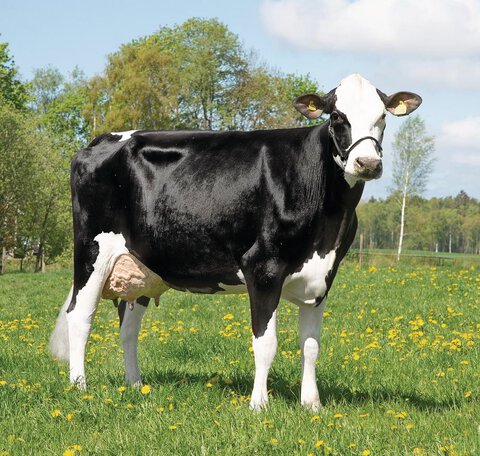
In the picture: ProCROSS cow daughter of VH Neptune, from Anders Nilsson's herd Skråmered in Sweden.

Discover ProCROSS
ProCROSS cow daughter of VH Neptune
+9% Daily Profit with ProCROSS cows compared with Holsteins Discover ProCROSS
ProCROSS cows

Sign up for our Innovative Breeding newsletter

Find out how much annual extra profit you could make by switching from Holstein to ProCROSS! Calculate now
ProCROSS cows